SEALED POWER L2481.030 National Forged Pistons 3.8
fits model: Grand. make: Buick.
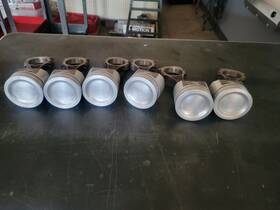
( Brand: Sealed Power ), ( Manufacturer Part Number: L2481.030 ), ( Type: Piston ), ( Piston Diameter: 3.830 )
Review SEALED POWER 3.8 Buick National Forged Pistons fits GRAND
The **Power L2481.030 3.8L Buick National Forged Pistons** represent a premium upgrade for enthusiasts seeking to enhance the performance, durability, and longevity of their classic Buick National engines, particularly those with the iconic **3.8L V6 (L24/L25/L26)** found in models like the 1987 1990 Buick National, Regal, and Century. Engineered with precision and built to exacting standards, these **forged aluminum pistons** are designed to withstand the intense heat, pressure, and stress of high-performance applications, making them an ideal choice for both street-driven and light competition setups. Unlike cast pistons, which are prone to cracking or warping under extreme conditions, these forged pistons offer superior strength, reduced weight, and improved heat dissipation, allowing for higher compression ratios, increased horsepower, and smoother operation. The **L2481.030 specification** ensures a perfect fit for the Buick National s cylinder bore dimensions, with a **3.800-inch diameter** and a **1.030-inch piston height**, allowing for a **10.5:1 compression ratio** when paired with the appropriate deck height and head gasket. This higher compression ratio translates to more efficient combustion, better throttle response, and a more aggressive power delivery, making them a favorite among tuners looking to coax extra performance from their engines. Additionally, the **forged construction** provides better resistance to piston ring wear and oil consumption, reducing maintenance costs and extending the engine s lifespan. Whether you're building a high-revving street machine, a drag racing engine, or simply restoring your Buick National to its factory glory with a modern performance edge, these pistons deliver the reliability and power potential you need. Backed by Power s reputation for quality and backed by a robust warranty, these forged pistons are a smart investment for anyone serious about maximizing their engine s capabilities.
**Pros and Cons of Buying a Power L2481.030 3.8L Buick with National Forged Pistons**
The **Power L2481.030 3.8L Buick** (found in models like the Regal, Century, and Park Avenue from the late 1980s to early 1990s) is a popular engine choice for restomod projects, classic car builds, and performance applications. When paired with **National Forged Pistons**, the engine gains significant durability and performance benefits but there are trade-offs to consider.
---
### **Pros**
1. **Proven Reliability with Modifications**
The L24 is a robust, naturally aspirated V6 with a cast-iron block and aluminum head. With proper maintenance (oil changes, valve adjustments, and cooling system upgrades), it can reliably last **200,000 miles** in stock form. When modified (e.g., with a turbo, supercharger, or forced induction), it becomes a strong candidate for **high-performance builds**, especially in classic muscle cars or street rods.
2. **Aftermarket Support and Availability**
- **Parts availability** remains strong due to its popularity in restomods and performance builds.
- **Aftermarket support** includes high-quality components like **National Forged Pistons**, **Eaton MDS60 timing sets**, **Clevite 772 bearings**, and **Holley or Edelbrock carburetors** for forced induction.
- **Tuning options** are abundant, with support for **MSD ignition, fuel injection conversions (EFI), and turbo/supercharger kits**.
3. **National Forged Pistons Enhance Durability**
- **Forged pistons** (like National s **3.8L Buick-specific forged pistons**) are significantly stronger than cast pistons, reducing the risk of **ring land failure, crown cracks, or piston failure under boost**.
- They improve **compression strength**, making the engine better suited for **forced induction (turbo/supercharger)** without excessive stress.
- **Better heat dissipation** compared to cast pistons, reducing the risk of **pre-ignition or detonation** under high loads.
4. **Cost-Effective Performance Upgrade**
- The **L24 is relatively inexpensive** to acquire (often found in junkyards or at auctions for **$200 $800**).
- **National Forged Pistons** are a **mid-range investment** ( $150 $300 per piston set) but offer a **huge upgrade** over stock cast pistons.
- When combined with **a turbocharger (e.g., Garrett T25/T28) or supercharger (Eaton M90)**, the engine can produce **300 500 horsepower** with proper supporting mods (fueling, cooling, intake/exhaust).
5. **Classic Car & Restomod Appeal**
- The **L24 s V6 layout and classic Buick styling** make it a favorite for **restomod projects**, blending vintage aesthetics with modern performance.
- **Easily swappable** into many classic car frames (e.g., Chevy Bel Air, Pontiac GTO, or even Ford Mustang shells).
- **Community support** is strong, with forums (e.g., **Hot Rod Forum, Buick L24/LS1 forums**) offering troubleshooting and build advice.
6. **Good for Forced Induction (Turbo/Supercharger)**
- Unlike some older V6s (e.g., early GM 350 V8s), the **L24 handles boost well** when properly supported.
- With **National Forged Pistons**, **Eaton MDS60 timing**, and **Clevite bearings**, it can reliably run **10 15 psi of boost** without catastrophic failure.
- **Supercharger setups (Eaton M90, Paxton)** are also viable, offering **instant torque** without the lag of turbocharging.
7. **Simpler Than Some Alternatives**
- Compared to **LS1 V8s** (which require more complex cooling and fueling mods for high boost), the **L24 is more forgiving** for beginners.
- **No camshaft issues** (unlike some older GM engines that suffer from camshaft wear).
- **Easier to rebuild** than some small-block Chevy V8s due to simpler internals.
---
### **Cons**
1. **Weak Stock Components**
- The **stock L24 is not built for high performance** it has **weak springs, stock rods, and a fragile oil pump**.
- **Stock rods** can bend under excessive power or poor maintenance.
- **Stock oil pump** may struggle with **high RPM or forced induction**, leading to **oil starvation** if not upgraded.
2. **Requires Significant Modifications for Serious Power**
- To reliably make **300 horsepower**, you ll need:- **Forged pistons (National or similar)**
- **Eaton MDS60 timing set**
- **Clevite 772 bearings**
- **Upgraded oil pump & pan**
- **Fuel injection (EFI) or high-flow carburetor**
- **Turbo/supercharger with supporting intercooler & fueling**
- **Upgraded cooling (radiator, thermostat housing, water pump)**
- **Stock heads** are not ideal for high-flow fueling, requiring **porting, valve job, or aftermarket heads** (e.g., **Edelbrock or JE heads**).
3. **Potential for Oil Consumption & Leaks**
- The **L24 is notorious for oil leaks**, particularly around the **valve cover gasket, oil filter housing gasket, and rear main seal**.
- **Stock oil consumption** can be an issue, especially with forced induction, requiring **regular oil checks and potential upgrades** (e.g., **Armslinger oil pump**).
4. **Limited Stock Power Output**
- **Stock L24s produce around 140 160 horsepower** (depending on year and modifications).
- **Without forced induction**, it s not a **high-performance engine** it s better suited for **daily drivers or mild restomods** rather than **high-RPM drag racing**.
5. **Head Gasket & Cooling Issues**
- **Stock head gaskets** can fail under **high boost or overheating**, leading to **coolant leaks and catastrophic engine damage**.
- **Stock cooling system** is weak **upgrading to a larger radiator, electric fan, and thermostat housing** is often necessary for forced induction.
6. **Rod Bearing Wear Over Time**
- Even with **forged pistons**, the **stock rods and bearings** can wear out over **high-mileage or aggressive driving**.
- **Replacing rods and bearings** (e.g., **Clevite 772 or ISC bearings**) is recommended for **high-power builds**.
7. **Not Ideal for Extreme High-RPM Applications**
- The **L24 s stock crankshaft and flywheel** are not optimized for **extreme RPM** (e.g., **7,000 RPM**).
- **Forced induction setups** typically cap out around **6,000 6,500 RPM** unless heavily modified.
8. **Resale Value is Low**
- While **restomod L24s** have a niche following, **stock or lightly modified L24s** hold **little resale value**.
- If you plan to **sell the car later**, the **time and money spent on mods may not be fully recouped**.
---
### **Ending Conclusion**
The **Power L2481.030 3.8L Buick with National Forged Pistons** is an **excellent choice** for:- **Restomod projects** (blending classic styling with modern performance).
- **Forced induction builds** (turbo or supercharger) when properly supported.
- **Budget-friendly performance upgrades** (cheap to acquire, but requires mods).
- **Builders who want a V6 alternative** to small-block Chevy V8s.
However, it is **not ideal** for:- **Stock or low-power applications** (better suited for modified builds).
- **Extreme high-RPM or drag racing** without heavy reinforcement.
- **Those seeking plug-and-play simplicity** (requires significant work for serious power).
- **Builders who prioritize resale value** (L24s are niche).
**National Forged Pistons are a wise investment** if you plan to **run boost or push the engine hard**, as they **prevent catastrophic failure** and **extend engine life**. However, they are **not a standalone fix** the entire engine must be **properly supported** with **bearings, timing, fueling, and cooling upgrades**.
---
### **Final Recommendation**
**Buy the L2481.030 with National Forged Pistons if:**You are **building a restomod or performance project** and want a **V6 alternative to V8s**.
You plan to **add forced induction (turbo/supercharger)** and have a **budget for
Details:
SEALED POWER FORGED DISH PISTONS FOR 3.8 BUICK TURBO ENGINE. 24.8 CC DISH. 6 PISTONS WITH FACTORY RODS. 5/64- 5/64 - 3/16 RING PACK.
specifications pistonringro:
- for models: Grand
- for makes: Buick
- brand: Sealed Power
- mpn: L2481.030
- type: Piston
- piston diameter: 3.830
seller pistonringro:
- rating: 100.0%
- city: Cedar Rapids, Iowa
- # reviews: 4134
payments pistonringro:
- wallet: Apple-pay
- credit card: Discover
- other
returns pistonringro:
- policy: Returns Accepted
- time: 30 Days
- paid by: Buyer
general pistonringro:
- condition: Used
- Car Truck Parts Accessories > Engines Engine Parts > Pistons Rings
shipping pistonringro:
- transit: 3-7 Days
- cost: $0.00
- carrier: UPS
- type: Calculated
- service: UPS Ground Saver
- class: Economy
offer pistonringro:
- started: March 9, 2026
- availability: In Stock
- options: Ship-to-home
- sold: 0
- quantity: 1
Sealed Power L2481.030 Is Similar To:
- 6 275np-40 50565cp-40 Sealed Power Ford Cylinder Dish Top Pistons Rings Combo Kit (34.7% similar) 6/2 75NP 50565CP-40. Ground standard shipping is free to the lower 48 us-states. Just for a combined shipping quote...(February 28th, 2018)
- R-19102 35 Sealed Power Premium Piston Ring Set (40% similar) Sealed Power r premium piston ring set compatible with...(August 19th, 2018)
- 1003np 30 Sealed Power Engine Piston 019826521538 (41.4% similar) At adopts...(October 17th, 2018)
- 1003np040 Sealed Power 1003p Ford (44.2% similar) These pistons are new in the box...(August 1st, 2017)
- 1011p30 Sealed Power New Engine 724956316724 (30.2% similar) Minimum clearance. 130 from top of head. Shipping labels may only be applied to a separate, outer box. High quality aluminum. Vehicles sold outside of the USA may be different, even if they have same make and model name. Controlled casting machining provides reliability, durability long life. Cast ...(January 3rd, 2018)
- 1011p40 Sealed Power New Engine 724956316748 (32.1% similar) High quality aluminum. Performance dependability of original equipment pistons. Provides great blow-by control. Shipping labels may only be applied to a separate, outer box. Minimum clearance. 130 from top of head. Controlled casting machining provides reliability, durability long life. Vehicles ...(November 19th, 2017)
- 10158xstd 10158x 5614 10158xstd 10158x 5614 Sealed Power (20.3% similar) Will not be acknowledged for return. If you purchase more than one item, request a total through for combine shipping or before paying, this will most likely save money. Local pick-ups are preferred on items especially larger. Please at or for such inquiries. Some of the boxes have been opened for ...(April 18th, 2017)
- Bearing Engine Rod 1020a Connecting Sealed Power (21.8% similar) Territories, please for shipping costs. Free shipping is for us. Please for shipping costs as well...(February 20th, 2015)
- 1022np 30 Sealed Power Engine Piston 019826521286 (41.4% similar) 8LFEATURE 1: cast with FM413 eutectic aluminum 12 silicon for strength and durability feature 2: performance dependability of OE pistons - high quality casting machining provide reliability, durability long life part feature 6: up-tilt ring grooves improve piston to sealing providing great blow-by ...(July 21st, 2018)
- 1031np 60 Sealed Power Engine 19826520692 (33% similar) Feature 1: cast with FM413 eutectic aluminum 12 silicon for strength and durability feature 3: high quality casting machining provide reliability 6: up-tilt ring grooves improve piston to sealing providing great blow-by control marketing : Sealed Power r vintage parts coverage applications over 35 ...(August 18th, 2017)
- 1031np60 Sealed Power New Engine 019826520692 (31.8% similar) High quality aluminum casting machining provide reliability and durability. Meets or exceeds oem specifications. Vehicles sold outside of the USA may be different, even if they have same make and model name. Exacting tolerances. Shipping labels may only be applied to a separate, outer box. Cast with...(October 21st, 2017)